
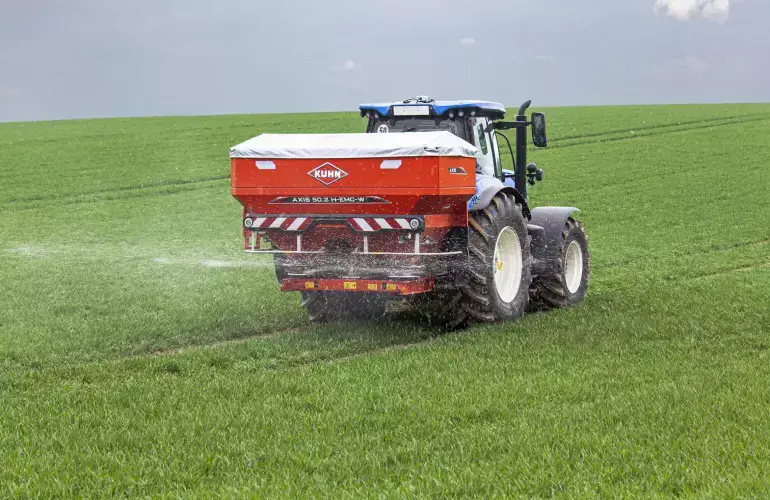
Whether you manage a smallholding, a sports field, or hundreds of acres of farmland, spreading materials such as artificial fertiliser, lime, or sand accurately is one of the most important jobs on the land. Poor application rates can waste money, damage crops, reduce soil quality, and create unnecessary environmental problems.
One of the simplest but most overlooked tools in achieving accurate spreading is the operator’s manual for the machine being used.
Every Material Behaves Differently
Artificial fertilisers, lime, and sand all flow and spread differently. Fertiliser granules are usually light and uniform, lime can be dusty and uneven, while sand is heavy and requires completely different settings and machinery adjustments.
Because of these differences, a spreader cannot simply be “set by eye.” The machine must be calibrated correctly for:
- Material type
- Particle size
- Moisture content
- Working width
- Forward speed
- Desired application rate
Even a small error can make a major difference over a large area.
The Cost of Incorrect Application Rates
Applying too much fertiliser increases costs and may scorch crops or grass. Excess nutrients can also wash into watercourses, causing environmental damage and possible legal issues.
Applying too little can reduce crop yields, weaken grass growth, and waste valuable field operations.
The same applies to lime. Too much lime can upset soil pH balance, while too little may fail to correct acidic conditions properly.
With sand applications, uneven spreading can create poor drainage areas, inconsistent root zones, or uneven surfaces on sports grounds and amenity areas.
Why the Operator’s Manual Matters
Many operators rely on experience alone, but every spreader model works differently. The operator’s manual provides the correct information for:
- PTO speeds
- Disc settings
- Hopper adjustments
- Calibration methods
- Recommended forward speeds
- Safe operating procedures
- Maintenance intervals
Without the manual, operators often guess settings, leading to inaccurate spreading and unnecessary wear on machinery.
Modern spreaders are increasingly sophisticated, with hydraulic controls, electronic rate systems, GPS compatibility, and variable-rate technology. Even experienced operators benefit from having the correct manual available.
Important for Smallholders and Large Farms Alike
There is sometimes a belief that calibration only matters for large-scale farming operations. In reality, accurate spreading is just as important for smallholders.
A small acreage operation may have tighter budgets and less room for costly mistakes. Over-applying fertiliser to a few paddocks can quickly become expensive.
Large farms face the same issue on a greater scale. A minor calibration error across hundreds of hectares can result in significant financial losses.
In both cases, the operator’s manual becomes an essential reference tool rather than just paperwork stored in a drawer.
Better Accuracy Means Better Results
Correct application rates help achieve:
- Improved crop performance
- Healthier soil conditions
- Reduced input costs
- Better environmental protection
- More even field coverage
- Longer machinery life
Taking time to calibrate equipment properly and consult the operator’s manual before starting work can save considerable time and money later.
Final Thoughts
Spreading fertiliser, lime, or sand may appear straightforward, but achieving accurate application rates requires attention to detail. The correct machine settings, proper calibration, and access to the operator’s manual are all essential parts of the process.
Whether you are a smallholder maintaining a few acres or a large-scale operator managing extensive land, accurate spreading is one of the foundations of efficient land management.